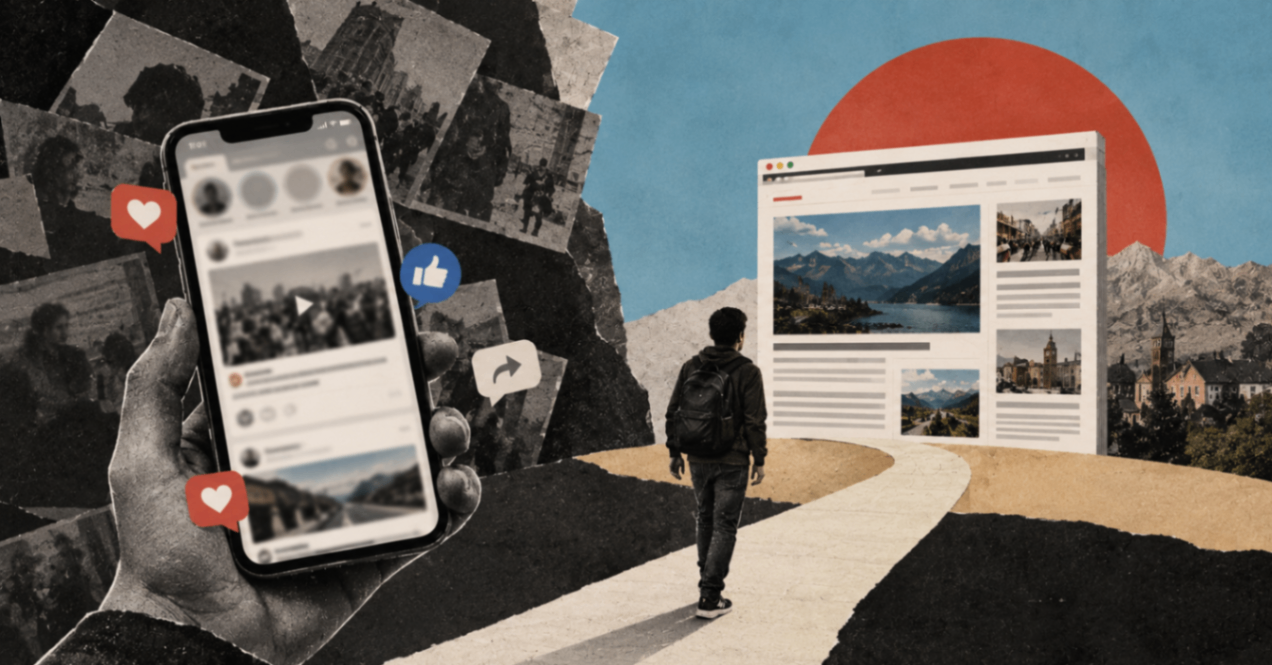
I joined Facebook sometime around 2012 or 2013. At that time, Facebook felt like a completely new kind of internet to me. I was young and, like many people around me, fascinated by the fact that so much information was suddenly available in one place. I could see what my friends were doing, find new people, share photographs, watch videos (if UC Browser or Opera Mini agreed to cooperate), discover memes and, more importantly, keep up with what was happening around me. I don't even remember when I started following news pages or why I did it. I simply had a habit of wanting to know what was happening, whether it was a local event, a change in the weather, a strike, a curfew, something happening in the city or a bigger story from somewhere else.
This was also the time when Facebook pages were becoming an important way for people to discover local information. Pages like Quick News Services (QNS), Kashmir Despatch, Sach News and The Varmul Post were locally active and quite well known. There were also very local Facebook pages with names that almost felt like inside jokes, such as "Papa Papa Az Cha Harta Na Gobur Az Chi Curfew." Looking back, these pages were doing something that seems normal today but was still relatively new then. They were turning social media into a kind of informal news bulletin. You opened Facebook and, along with photographs from your friends and random posts, you could find out what was happening around you.
But there was an important difference between those pages and the way news is consumed on social media today. Back then, Facebook was often where you discovered a story, but the story itself still lived on a website. A news page would post a headline, an image and a link. You would click it, the browser would open the news website and you would read the full article there. Facebook was becoming the road that took readers to news websites rather than becoming the newspaper itself.
That relationship was extremely valuable to publishers. During the early 2010s, a news website still had a clear identity of its own. If you wanted to know what was happening, you could open the website of a publication you trusted and browse its homepage. The homepage was essentially the front page of a newspaper translated to the internet. The most important story would get the biggest space, other important stories would be arranged around it, and sections such as politics, local news, business, sports and entertainment gave readers a sense of what was happening that day.
For readers, this was useful because you did not have to know exactly what you were looking for. You could simply open a website and browse. The homepage gave you a summary of what the publication considered important. In a way, it was an editor's answer to a simple question: if you only have a few minutes, here is what you should know today.
Social media soon changed that relationship. By the early 2010s, Facebook was becoming a major source of news, with Facebook reporting in 2013 that average referral traffic from the platform to media websites had increased by more than 170 percent over the previous year. By 2016, Reuters Institute found that 51 percent of people across 26 countries used social media for news each week, with Facebook leading the way. Among 18–24-year-olds, social media had even overtaken television as the most common news source.
For publishers, this was an opportunity that was difficult to ignore. They needed readers, and Facebook had millions of them. A publisher could create a story on its own website, post a link to Facebook and potentially reach a much larger audience than it could by relying only on people who already knew the website. The website still got the pageview, the publisher still had its advertising and the reader still ended up on the publisher's own property. It looked like a very good arrangement.
The problem was that once publishers realised how much traffic Facebook could send them, they also realised how important it was to make people click. This was the beginning of the great clickbait era.
A headline no longer had to simply explain what had happened. It had to compete with everything else appearing in a person's Facebook feed. A straightforward headline such as "Heavy Rain Causes Flooding in Srinagar" had to compete with dozens of other posts, photographs, videos and updates. A more exaggerated headline that created curiosity had a better chance of getting the click. The more clicks a story received, the more traffic it generated for the publisher.
Facebook itself eventually began fighting the clickbait problem. In 2014, it said it would use signals such as how long someone stayed on an article after clicking it to help identify stories whose headlines were misleading or failed to deliver what they promised. In 2016, Facebook announced further changes designed to reduce headlines that withheld important information or exaggerated an article's content. The platform was already trying to deal with a problem that its own success had helped create: publishers were becoming increasingly dependent on winning attention inside a feed they did not control.
But clickbait was only the beginning of the larger change.
The more successful Facebook became as a distribution system, the less important the homepage of a publication became for many readers. Instead of opening a news website and browsing its front page, people increasingly arrived at individual articles. Someone would share a story on Facebook, you would click it, read that story and leave. The next day you might arrive through another link. Eventually, the website became a collection of individual pages rather than a destination that people deliberately visited.
The change was not immediate, and it did not happen equally everywhere. Established news brands continued to have large audiences coming directly to them. But the general direction of the web was clear: news was becoming something that came to you instead of something you went looking for.
In 2016, the Reuters Institute described this shift as the rise of "distributed news". Its research found that social media was no longer simply helping people find news websites. An increasing amount of news was being consumed directly through social platforms, with Facebook becoming particularly important. Publishers were also experimenting with new formats that allowed readers to consume more of the news without leaving the platform.
Facebook took this idea even further with Instant Articles in 2015. Instead of clicking a link and leaving Facebook to open a publisher's website, readers could read the complete article inside Facebook. Facebook promoted Instant Articles partly around speed, saying they could load as much as ten times faster than standard mobile web articles. For readers, it was convenient. For publishers, it offered new ways to distribute and monetise their journalism while keeping the experience inside Facebook.
This was an important moment because the relationship had changed. Earlier, Facebook was helping publishers bring people to their websites. Now Facebook was also giving publishers a way to publish their journalism without requiring the reader to visit the website at all.
That was convenient until publishers started asking a difficult question: if readers can consume our journalism without visiting our website, what exactly belongs to us?
The answer became increasingly uncomfortable. The audience might look like it belonged to the publisher, but the publisher did not control the relationship. Facebook controlled the feed and the ranking. It could decide which stories were shown, how many people saw them and what kind of content received priority. A publisher could spend years building a large following and still see its reach change because of an algorithm update.
This became one of the biggest lessons of the social-media era. Publishers had built enormous audiences on platforms they did not own.
For a while, the traffic was so valuable that the risk did not seem particularly important. Then the platforms changed direction. Facebook began putting more emphasis on other types of content, particularly video and later creator content. News became less central to the experience. Other platforms followed their own strategies. Instagram became increasingly focused on visual and creator content, while TikTok built a completely different model around short-form video and recommendation algorithms rather than the social graph. (TikTok was banned in India in 2020)
The result was that publishers could no longer assume that posting a link would produce the traffic it once did.
Over the years, that relationship started changing. Facebook was no longer sending the traffic it once did, and publishers were finding social referrals increasingly unreliable. They had built audiences on platforms whose priorities could change at any time. Search became another important gateway, but it brought its own uncertainties.
The great Facebook-to-news-website highway was disappearing.
Publishers had spent years learning how to make their content work on Facebook. They changed headlines, formats, publishing schedules and even the way stories were written. Some built entire teams around social distribution. But when the platform decided that news was no longer as valuable to it, publishers could not simply tell Facebook to change its mind. They had built part of their business on rented land.
Search engines became the next major source of traffic. For years, Google was one of the most important ways for people to discover information on the web. Someone would type a question into Google, see a list of websites and click on one of them. This was different from Facebook because the user was actively looking for something, but the basic dependency was similar. The publisher still depended on another company to decide whether the reader would reach its website.
Then artificial intelligence started changing that relationship too.
Search engines are no longer just showing us where to find information. They are increasingly giving us the information directly. AI systems can pull information from multiple sources, summarise it and provide an answer without requiring us to visit the original websites. For publishers, this creates another problem: if readers can get the information without leaving the search page, fewer of them may have a reason to visit the websites that produced it.
The irony is that the internet has spent the last fifteen years moving further and further away from the original website. First, the website was the destination. Then Facebook became the place where people discovered the website, before eventually becoming the place where they could read the article itself. Search engines became another major gatekeeper, and now AI systems are beginning to answer questions without requiring readers to visit the website at all. At the same time, another change is becoming increasingly obvious to anyone who spends a lot of time online: there is simply too much content.
Social media feeds are no longer made up primarily of posts from people you know and publications you deliberately chose to follow. They are filled with recommended videos, recycled stories, automatically generated images, synthetic voices, AI-written posts, copied articles and accounts producing enormous amounts of content. Generative AI has made it possible to create content at a scale that would have been difficult to imagine only a few years ago. The problem is no longer simply finding information. It is finding something worth paying attention to.
This is where I started noticing something interesting in my own work.
I work with a number of websites in the news space, and over the last year several publishers have approached me about redesigning their homepages. The reason was not simply that the websites looked old or that they wanted a more modern design. They wanted their homepages to work better as destinations because they were seeing more value in people coming directly to the website.
That caught my attention because it felt like something from an earlier version of the internet was quietly becoming relevant again.
For years, the homepage had seemed less important. If most readers arrived through Facebook, Google or some other platform, why spend too much time thinking about the front page? A reader might never see it anyway. They would land directly on an article and leave.
But a direct visitor is different. Someone who opens a news website because they deliberately want to see what that publication is reporting is making a different kind of choice. They are not being shown a story simply because an algorithm decided it might keep them engaged. They have gone looking for a particular publication.
That distinction matters even more now because the amount of information available to us has become almost impossible to process. People are overwhelmed by the sheer volume of content and increasingly need news organisations that can filter through it, provide accurate and original reporting, and help them understand what actually matters. In a world where platforms and creators compete for our attention, a trusted publication can offer something different: a place where someone has already done some of the filtering for you.
This is where I think the homepage has an opportunity to become useful again.
Not because we are going back to the old internet, and certainly not because social media is disappearing. Social media is still an enormous part of how people discover news. The 2026 Digital News Report says 54 percent of people globally use social media and video networks for news, rising to 56 percent when AI chatbots are included. At the same time, the report says news websites themselves have fallen behind these third-party sources in overall weekly use.
So the homepage is not going to replace Facebook, YouTube, Instagram, TikTok, Google or AI, and it does not need to. Its job can be something different.
A good news homepage can give readers a place where someone has already done some of the filtering for them. It can show the most important local story, the major national development, the international story that actually matters, the latest sports result and the stories that deserve more context. It can put something important at the top even when it is not the story generating the most clicks. It can make editorial decisions based on importance rather than simply engagement.
That is something a social feed is not necessarily designed to do.
A social platform wants to keep you inside the platform. A recommendation system wants to predict what you are likely to watch or click next. An AI system wants to give you an answer as quickly as possible. A news homepage can do something much simpler: it can tell you what the people behind that publication think is worth knowing today. Not what is most likely to keep you engaged, but what is important, relevant and worth understanding in the context of what that publication covers.
There is another important difference. A website usually has a clear editorial focus. It might be dedicated to local news, national or international affairs, technology, business, sports or another specific subject. Social media, on the other hand, is a public square. You might see an important local news story on one scroll, a meme on the next, a celebrity post after that and then a completely unrelated video. That variety is part of what makes social media useful, but it also means that the information you care about is constantly competing for your attention with everything else on the platform.
That difference becomes more valuable when the internet is full of noise.
There is also a business reason why publishers should care about this again. A follower on Facebook is not quite the same thing as a reader who visits your website every morning. Someone who happens to see your story in an Instagram feed is not the same as someone who remembers your publication, types its address into a browser or opens its app because they want to know what you are reporting.
The first relationship belongs partly to the platform. The second belongs much more to the publisher.
That is why the current moment feels less like the death of the homepage and more like a return to something publishers temporarily stopped paying attention to. The homepage is valuable when the publication itself is valuable enough for people to visit.
The challenge for news organisations is therefore not simply to make a prettier homepage. It is to give people a reason to come back to it. That could mean better local reporting, faster breaking news, better organisation, useful explainers, strong editorial judgment, fewer low-value stories and a clear sense of what the publication actually stands for. It could also mean newsletters, apps, notifications and other direct channels that remind readers that they can come to the publication without waiting for a social platform or search engine to send them there.
In other words, the real comeback is not necessarily the comeback of a particular webpage. It is the comeback of the destination.
For a long time, the internet trained us to think that the best way to consume news was to let someone else bring it to us. First it was social networks, then recommendation algorithms and now increasingly AI systems. Each one made the experience more convenient, but each one also put another layer between the reader and the publication that originally produced the journalism.
The next phase may be about rebuilding that direct relationship.
I find it interesting that my own experience of the internet almost mirrors this entire cycle. When I first discovered Facebook in the early 2010s, it felt like a place where I could discover everything. News websites were still destinations, and Facebook was simply helping me find them. A few years later, Facebook itself had become the place where much of the news was consumed, and publishers were adapting their entire businesses around that reality. Then the platforms changed, traffic moved elsewhere and publishers realised how dangerous it was to depend too heavily on somebody else's algorithm.
Now we have reached another strange point. The internet has more information than ever before, but finding something genuinely worth reading can sometimes feel harder than it did when there was far less content. AI has made producing information easier, social platforms have made distributing it easier and algorithms have made selecting it easier, but none of those things necessarily make the information itself better. That may be why the simple homepage is starting to feel useful again, not because people suddenly want to return to 2010, because social media has failed completely or because the old model of publishing is coming back exactly as it was.
The homepage matters when readers want to know that there is a real publication behind what they are reading, with real people making decisions about what deserves their attention. It gives readers a place to go deliberately rather than simply waiting for an algorithm to decide what appears in front of them.
For a while, we thought the future of news meant removing the homepage from the equation and letting platforms bring the news to us. Now, after years of algorithmic feeds, disappearing referral traffic and an internet increasingly filled with machine-generated content, I think we may be rediscovering the value of going somewhere deliberately. Not because the homepage is the future of the internet, but because sometimes it is useful to have a place where someone has already decided what is worth your time.
You open a website, look at its homepage and see what is happening. You choose what you want to read, rather than having an algorithm make that decision for you. If the publication does its job well enough, you come back tomorrow.
Maybe the news homepage was never really dead. Maybe we just spent the last decade forgetting why it was useful in the first place.