Last year I did something that would have seemed crazy to me three or four years ago. I opened my Facebook friends list, and I deleted nearly three thousand people.
I went from having 5,000 "friends" down to about 2,100. I thought this digital cleaning would fix my feed. I told myself that if I just removed the strangers, the bots, and the people I met once at a random wedding five years ago, I would start seeing my real friends again. I wanted to see their vacation photos. I wanted to read their random thoughts about the weather. I wanted the internet to feel like a community again.
It did not work.
Even after the massive cleanup, my timeline remained a ghost town. It was not that my friends were gone. It was that they were silent. I scrolled and scrolled, but instead of seeing a cousin’s wedding photo or a friend’s opinion on a movie, I saw a sponsored video. Then I saw a suggested post from a page I do not follow. Then I saw an ad.
It hit me then: the social internet is dead. We are all still here, logging in every day, but we have stopped talking.
The Era of "Posting Zero"
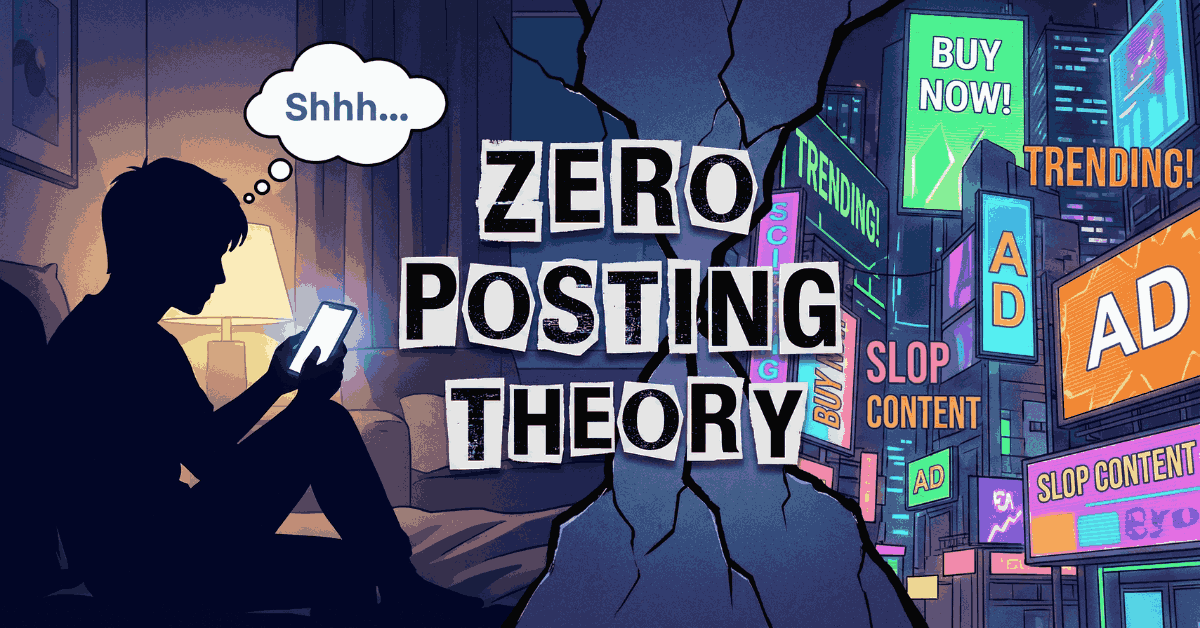
I am not the only one feeling this. Kyle Chayka, a writer for The New Yorker, recently gave a name to this phenomenon. He calls it "Posting Zero."
He describes it as a massive cultural shift where the average person has turned into a "lurker." We consume content, we scroll through videos, and we watch other people, but we do not contribute anything ourselves. Think about it. When was the last time you posted something just for fun? I am not talking about a "Story" that disappears in twenty-four hours. I am talking about a real, permanent post.
For me, the gap is embarrassing. I have a "Legacy Verified" Facebook account—the blue tick that used to mean something special before Elon and Zuckerberg started selling them for a monthly subscription. Back in 2017, posting was like taking medicine. It was a daily routine. I was what you would call a "Social Media Power User." I posted memes three or four times a week. I debated in comment sections. I lived my life online.
Now, my profile looks like a time capsule. I last changed my profile picture in August 2024. Before that, I had not touched it for a year. My last actual post was an announcement about my new website, Heal Your Heart. Before that? The gaps tell the story. May 2025. December 2024. June 2024. The silence is getting longer. It is like a heartbeat slowing down before it stops completely.
The Mall vs. The Public Square
So, why did we stop?
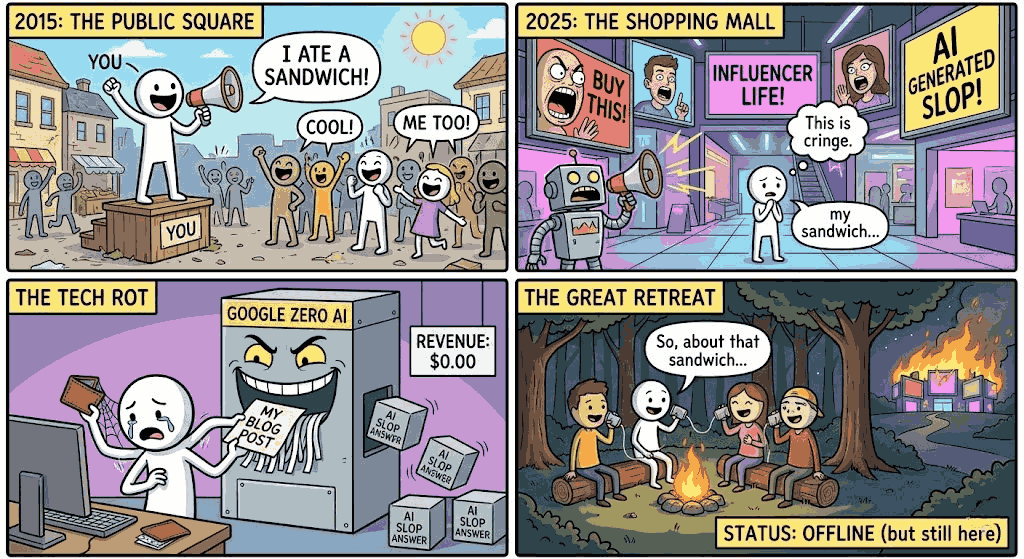
The "Zero Posting" theory argues that social media used to be a Public Square. You stood on a box, you shouted your news to your friends, and they shouted back. It was messy, but it was human.
Today, that square has been bulldozed. It is now a Shopping Mall. The mall is filled with screaming billboards (ads), robots (AI content), and professional performers (influencers). If you try to shout to your friends now, nobody hears you over the noise. And honestly, it feels weird to shout about your personal life in the middle of a shopping mall.
This brings us to the fear. It is a digital form of Stage Fright. When you scroll through your feed today, you don't just see life updates; you see performances. You see perfectly edited travel videos, professional career announcements, and high-quality photography. In this polished environment, posting a blurry, raw photo of your life feels like walking onto a movie set in your pajamas.
It feels "cringe." We have convinced ourselves that if a post isn't perfect, it isn't worth posting at all. So I just give up. I do not post anything.
The Curse of the Personal Brand
There is a darker economic reason for the silence, too.
Unemployment and the rise of the "gig economy" have forced us all to become businesses. We are all freelancers now. We are all trying to build a "Personal Brand."
In 2017, you could be messy on the internet. You could be angry. You could be sad. Today, your social media profile is your resume. You cannot afford to look unprofessional because a future client might see it. The relationship between the follower and the person they follow has become a transaction. We do not want friends anymore. We want "leads." We do not want connection. We want "reach."
This pressure has stripped the humanity out of the web. We scrub our profiles clean. We delete old posts. We hide our true selves because being a real human being is bad for business.
Google Zero-Click
As a Computer Science student and a blogger, I see the code behind this tragedy. It is not just a cultural shift. It is a technical theft.
I used to manage pages with millions of followers. I had a rhythm: research the topic, open Canva, design the visual, write the caption, and schedule it. It was work, but it paid off because I could occasionally slip a link to my blog into the post. That link was my lifeline—it was the only way creators like me, who deal in text and images, could actually earn revenue.
It was a fair trade. I gave Facebook content, and Facebook gave me visitors.
Then, the algorithm changed. Zuckerberg decided he did not want anyone leaving his app. The system began to crush any post that contained a link to an outside website. My reach dropped to zero.
Then came the search engines. There is a concept called "Google Zero" (or Zero-Click Searches). It used to be that if I wrote a good article, Google would show it to people, and they would click my link. Now, Google’s AI reads my article, steals the information, summarizes it, and shows the answer directly on the search page. The user reads the answer and leaves. They never visit my website.
I used to get hundreds of views per post on one of my blogs; now I struggle for 100–200 pageviews on a good day.
The math is brutal. I create the content -> AI steals the content -> Google shows the content -> I get 0 clicks and 0 ad revenue. If nobody sees what I write, why should I write at all? Just to be free fertilizer for a trillion-dollar AI garden?
The internet is becoming a place where machines talk to machines. The "Dead Internet Theory" is coming true. We are generating petabytes of data just to train AI models, while real human interaction starves.
This explains the sudden explosion of "Micro-Communities."
Have you noticed that every YouTuber now wants you to join their Discord? Every writer wants your email address? Every influencer has a broadcast channel on Instagram or a private Telegram group?
It is not a coincidence. These creators have realized that building a following on social media is like building a house on rented land. The algorithm is a landlord that can evict them (or hide their posts) at any moment. By moving to WhatsApp, Subreddits, or email lists, they are trying to regain control. They are trying to build a direct line to humans, with no robot middleman blocking the way.
They are still playing by the platform's rules, of course. But these private groups are their loophole. It is the only place where they can skip the algorithm entirely and establish the one thing that actually matters: a direct line to you.
Into the Dark but Peaceful Forest
We have not stopped communicating. We have just stopped performing.
We realized that the "Public Square" was never really ours; it belonged to the advertisers, the algorithms, and the loudest voices in the room. So, we initiated the Great Retreat. We took our real lives off the main stage and moved them into the "Dark Forest" of the internet.
We migrated to the cozy, encrypted group chats, the private Discord servers, WhatsApp and Telegram groups, and the quiet DMs. In these corners, the "Personal Brand" does not exist. The algorithm cannot see us here. We didn't stop talking to our friends; we just stopped performing for the machines.
So, if you look at my timeline and see a ghost town, do not worry. I am not gone. I am reading. I am listening. But until the noise dies down and the humans return, I am staying quiet.
And I have a feeling that you are too.